


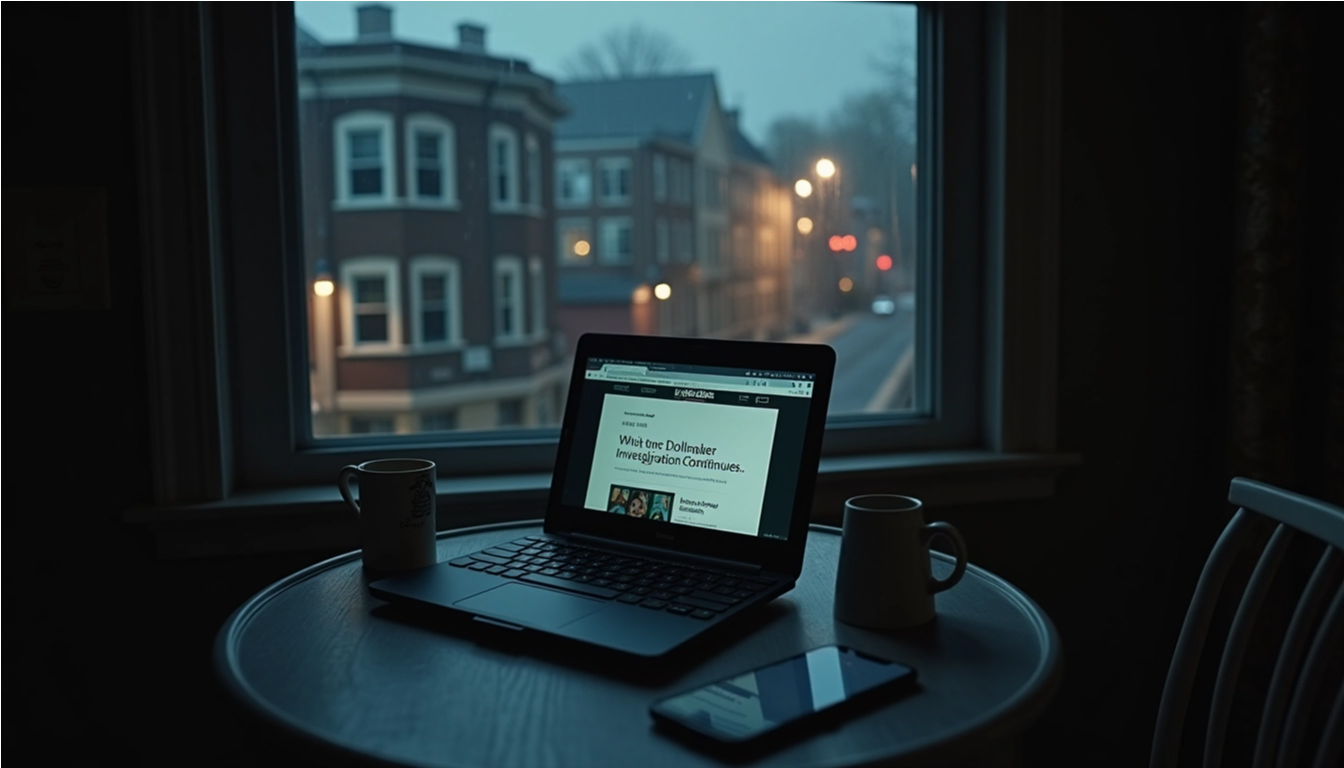
Patricia Moreno’s first Dollmaker article ran the same day as my suspension.
Not in print—online, on the Philadelphia Observer’s website where breaking news went live without waiting for the morning edition. I read it sitting in my apartment with coffee going cold in my hand and the kind of anger that makes your vision narrow at the edges. She’d taken my beat. Taken my sources. Taken the story I’d spent two months building—and she was getting it wrong.
“Dollmaker Investigation Continues As Police Pursue New Leads” - Philadelphia Observer
Philadelphia police continue their search for the serial killer known as the Dollmaker, whose victims have been found posed with elaborate chalk facial enhancements that investigators believe may be ritualistic in nature.
The investigation has expanded to include possible connections between the murders and ongoing labor disputes in the waste management industry. Detective Raymond Torres of the Philadelphia Police Department confirmed that investigators are “pursuing multiple angles” but declined to provide specifics about the direction of the probe.
The most recent victim, Maria Santos, was a community organizer who had been vocal about the impact of the PhilWaste strike on low-income neighborhoods. Her body was discovered in an empty lot in South Philadelphia, positioned carefully with what sources describe as “artistic precision.”
Police are asking anyone with information about the murders to contact the department’s tip line...
Six hundred words. Generic. Safe. The kind of article any reporter could have written by reading police press releases and adding filler.
She wasn’t investigating. She wasn’t connecting. She was just... reporting.
And it was working. Her byline was on the website’s homepage. Her editor was probably praising her restraint, her objectivity, her professional approach to a difficult story.
Everything I hadn’t been.
What I Knew About Patricia
We’d worked together for three years. Same newsroom. Same competitive environment. Same desperate scramble for homepage placement and editor approval.
Patricia was methodical. She built sources slowly, cultivated relationships with law enforcement and city officials, played the long game. She went to the same yoga studio three times a week—CorePower on Walnut Street, Tuesday and Thursday evenings, Saturday mornings. She ordered the same lunch from the same food truck every day. She was predictable in a way that made her easy to work around.
She was also ruthless.
The poker article wasn’t journalism. It was a calculated hit designed to eliminate competition. She’d buried my name in paragraph six because that made it look credible, made it look like she’d stumbled across my involvement while investigating something bigger.
She’d destroyed my career with one carefully crafted sentence.
And now she was profiting from it.

The Deluge
The next day, Patricia’s second article appeared in print.
“Dollmaker Victims Show Pattern in Selection, Staging” - Philadelphia Observer
An analysis of the three confirmed Dollmaker victims reveals a consistent pattern in both victim selection and post-mortem staging that may provide clues to the killer’s identity and motivation.
All three victims—Sofia Cavallaro, Rebecca Chen (who survived), and Maria Santos—were found or attacked in areas of South Philadelphia with known connections to organized waste management operations. The elaborate chalk application used to enhance their facial features appears to follow Renaissance artistic techniques, suggesting the killer may have formal training in art or art history.
“The level of detail in the staging indicates someone with significant knowledge of classical portraiture,” said Dr. Ellen Martinez, a forensic psychologist consulted by the Observer. “This isn’t random violence. This is someone trying to create something they perceive as beautiful or meaningful.”
Police have not confirmed whether the murders are connected to ongoing labor disputes in the waste management industry, but sources close to the investigation say that angle has not been ruled out...
I read it twice. Then a third time.
She was still pushing the mob angle. Still suggesting the murders were connected to the strike, to organized crime, to Marcuccio territory. She was writing the same story I’d written—the one the Dollmaker had called me about, the one he’d said was wrong.
But she was writing it carefully. Using qualifiers. “May provide clues.” “Appears to follow.” “Has not been ruled out.”
She was covering her ass while still building the narrative.
And it made me furious.
Three Articles in Twenty-Four Hours
That same day—the same day her print article ran—Patricia published a third piece online.
“Police Expand Dollmaker Investigation to Include Earlier Cases” - Philadelphia Observer
Philadelphia police are reviewing unsolved murders dating back six months to determine if additional victims may be connected to the serial killer known as the Dollmaker, according to sources familiar with the investigation.
The review includes cases where victims showed signs of post-mortem staging or artistic enhancement, though police have not confirmed specific cases under consideration.
Detective Raymond Torres emphasized that the investigation remains active and that the department is “pursuing all viable leads.” He declined to comment on whether the killer may have been active longer than previously believed...
Three articles in twenty-four hours.
She was flooding the zone. Establishing herself as the Observer’s Dollmaker expert. Making sure that when people thought about this story, they thought about Patricia Moreno’s byline.
My phone buzzed with notifications from former colleagues. Texts from other reporters asking if I’d seen Patricia’s coverage. Not malicious—most of them didn’t mean it that way—but every message was a reminder that I was out and she was in.
Generic. Safe. Completely lacking in any real insight.
But her byline kept appearing. Homepage. Print. Digital. While I sat in my apartment writing for forty-three subscribers and drinking bourbon at three in the afternoon.
The Call I Should Have Made
I sat with my phone in my hand for twenty minutes that afternoon.
The Dollmaker’s voice kept echoing in my head. What he’d said about Patricia. About her ambition. About how she was taking my work and profiting from my destruction.
“She’s not at bars,” I’d told him. “She does hot yoga three times a week. Obsessed with it.”
Why had I told him that?
I looked at her articles again. All three of them. The byline photo. Patricia smiling, confident, professional. The woman who’d destroyed my career with one sentence.
I could call her. Warn her.
Tell her what? That the Dollmaker had contacted me? That he was angry about being connected to the mob? That he’d mentioned her specifically?
She wouldn’t believe me. Nobody would. Suspended journalist claims serial killer called him to complain about coverage. It sounded insane.
And there was something else. Something I didn’t want to admit.
Part of me wanted her to suffer.
Not physically. Not like that. But professionally. I wanted her credibility destroyed the way mine had been. I wanted her to know what it felt like to have everything taken away by someone who didn’t care about truth, only advancement.
The Dollmaker had said it on the phone: “People like that never stop performing, do they?”
He was right.
I set the phone down without calling.
The Pattern I Missed
Over the next two weeks, Patricia published four more articles.
Each one careful. Each one generic. Each one building her reputation as the reporter covering Philadelphia’s most important crime story while saying absolutely nothing of substance.
I watched from the outside. Checked the Observer’s website obsessively. Read every word she wrote with the kind of attention you give to things that hurt you.
She was wrong about everything. Wrong about the mob connection. Wrong about the motivation. Wrong about what the Dollmaker was actually doing.
But she was safe. And in journalism, safe usually wins.
I checked her social media that week. Instagram showed her at CorePower Yoga, mat over her shoulder, face flushed from the heat. Caption: “Best way to clear your head after a long day. #yogalife #selfcare”
Thursday evening. Same routine. Same predictability.
I closed the app and poured another drink.
What I Didn’t See Coming
The last time I looked at Patricia’s work was a Thursday night in late October.
She’d published another Dollmaker update that afternoon—more police statements, more generic coverage, more careful language that said nothing while taking up six hundred words.
I was working on my own piece for Exposure, trying to explain why the mob angle was wrong without revealing too much about my conversation with the Dollmaker. Trying to rebuild credibility I’d already lost.
My phone was on the desk next to my laptop. Silent. Waiting.
I kept thinking about what the Dollmaker had said. About Patricia. About her ambition. About how she was profiting from my destruction while not even understanding what she was writing about.
“She doesn’t try,” he’d said. “She just fabricates and takes what others built.”
I should have called her then. Should have warned her.
But I didn’t.
I told myself it was because she wouldn’t believe me. Because nobody would take a suspended journalist seriously. Because trying to warn her would just make me look more unstable, more desperate.
But the truth was simpler.
I wanted her to fail.
I just didn’t understand what failure would look like.
Thursday Night
I don’t know exactly when Patricia left CorePower Yoga that Thursday.
I don’t know if she noticed the car following her. If she felt unsafe. If she thought about calling someone.
I don’t know if she fought back or if it happened too quickly.
All I know is that Friday morning, my phone lit up with news alerts.
Body found in South Philadelphia. Female. Posed. Chalk application around the eyes.
The Dollmaker had killed again.
And this time, I knew who it was before they released her name.
The voicemail I’d received days earlier suddenly made sense.
“I did something for you.”
He’d killed Patricia Moreno.
For me.